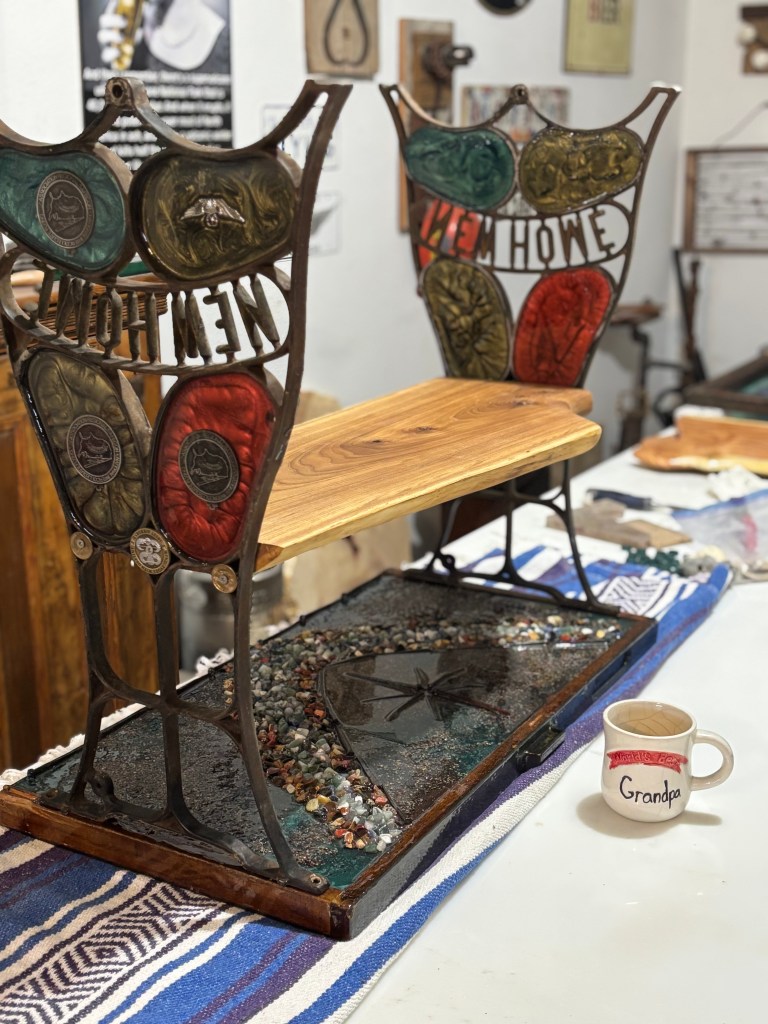
Just In Case
There is really no simple reason to assume I was supposed to be currently alive. The world has thrown everything in its arsenal at me, trying to put me down. Each occurrence should easily have done the trick, but for some reason, cruel or eloquent, I reach the point where I have to deal with the aftermath and ghosts of the past. And as time passes, those ghosts remain. They gather momentum, they gather numbers. That is the epicenter of the cruelty.
I do what I always did when I flew a helicopter into a tough situation: keep moving forward. Looking back does little to assist. This isn’t my life mantra, but it’s one that bounces around in my head from time to time. It’s a trusted technique, one I employ often. It either keeps me out of jams, or keeps me out of them for now. I’d way rather push off this heavy shit until later than face it now or anytime soon.
My business comes full circle back to this recurring image flashing through the synapses and neuroelectric currents traveling my brain. The grandfather that I met… there is a photo that proves it true. It’s of my two older twin brothers, my Grandpa Chuck, and me. I was at the center of attention for the other three. I was nothing but a small bud with all the proper parts and pieces, but just a fledgling. I, of course, do not remember the encounter.
The photo pushes my chemical buttons when I see it or think of it. Charles Ankeney survived only a few months beyond that photo. He was a very young 56 when a fatal heart attack took him from his family forever. Paths were altered that day. Outcomes changed. Potential went unfulfilled, unspent energy with nowhere to go.
Role modeling and mentorship meant to be levied by Grandpa Chuck toward his oldest child, Dell, and her children would be completed by someone else… or neglected altogether. No fucking way to tell. It’s all just off course, or it becomes a new course to the same destination, or…? It is what it is though. Tough it out or quit. Best to move forward.
His image flashing into my thoughts makes the reality, that I know very little about this man,a tragedy. I’ve always felt a connection, but could never justify why. I figured it was just another item on the long list of proof that I’m a whack job. My timing is really fucking bad in this regard. I should have spent hours upon hours asking my Grandma Rhae the right questions about him. She left me with all of his military awards.
She passed decades ago.
I have the ribbons and medals, but I lack the story behind these trinkets. Not many understand what any of those things mean or what it takes to get them. So few do, and I am the next in the family lineage that served in the U.S. Army. I now possess the deep knowledge and experience that makes me very interested to hear the story behind those awards.
Some are certainly for just being there. Not a small thing, but each soldier that was part of a campaign got the same award for service. When bigger, more prestigious awards are added to that particular campaign, it means special events occurred. Valor was in the air. Certainly, the value of Selfless Service was on full display.
Meaning that, in this case, my grandfather was the kind of man who jumped into action toward the threat, put his unit and mission before his personal safety and survival if needed. In particular, I hold his World War II Service Ribbon and also his Bronze Star. You can only get one of those during combat.
My mother was still quite young when her otherwise healthy-as-a-horse father fell dead almost instantly. At some point, she would have discovered her new reality: her father figure gone, her mother distraught and alone, and her three boys left without a maternal grandfather. None of this was good or welcome news, we can all be sure. His personality was big, just like his huge frame, now snuffed. This leaves voids that will be filled with alternate material.
Dell, my mother, should have been a treasure chest of information. She slowly went before my eyes and succumbed in 2021, the first year of the COVID-19 pandemic. Her inaction on too many difficulties plaguing multiple important systems took Dell out: game, set, match; at the too-young age of 72.
It’s still so soon since her passing that my initial thoughts are to call my mom and ask questions about her father. Why didn’t I do this before, when I had the fucking chance? I knew I wanted to. I just never did. I figured there was time down the road. I figured the road was longer. That I had more time.
I figured wrong.
Being correct about how much time you have is a fantasy. No one has a clue. Which means, at least to me, that there is no time like the present.
But that’s just what ugly people say.
It leaves me with this ever-increasing, nagging feeling that I have to get some info down for the sake of preserving history. Yeah, just my history, which is what feels so weird about this endeavor. I bet Chuck never thought once that he was so important or impactful that his story should be preserved. Check. I feel the same.
My guess is that me and Chuck are really damn similar. I mean, I think I’m the apple that didn’t fall far from his tree. I have no way of knowing if that’s true. It’s just a feeling, a haunting-ass, recurring, strengthening feeling that it’s more important than me. Bigger than me.
I wish I had a better grasp on my Grandpa Chuck’s history than I do. My own history might prove to be important to my family… maybe even to a family member that hasn’t arrived yet.
If I am that apple so near the tree, and if history tends to repeat itself, all the clichés, my time might be short. I’m fast approaching 56. Like, real fast. Deep into 55.
Alternate option? I’m creating a situation in which pressure to perform and an objective bigger than me are present. All the ingredients I love to stir up in order to motivate and bring out my absolute inner beast and best performance. Life or death has always made me perform at a level unchecked. I can never tap into that performance for something too menial.
It has to be something that could get a family or unit member killed.
I will never quit in those scenarios.
Couldn’t if I tried.
I know.
I have.
I did.
I didn’t.
Here I am.
The most probable course of action is also the most likely course of action. Almost always. However, I never ignore the most deadly course of action. Most plans begin there for me and work backward. If I can do the most difficult thing, an encounter with an easier outcome is always pleasant.
Plan for the worst, hope for the best.
Combined with: “Say what you mean, mean what you say.”
These two cliché phrases? Definitely my life mantra.
I like to be straight to the point; blunt as a bowling ball. No games played. No chance that my thoughts or feelings on something could ever be misunderstood. I leave out emotion in these situations. It’s a talent for me. I think for men in general, maybe, not sure.
I might be able to state that my thought patterns are also not well received by the normal civilian populace.
I might be weird.
Check.
So, I’m Doing This!?
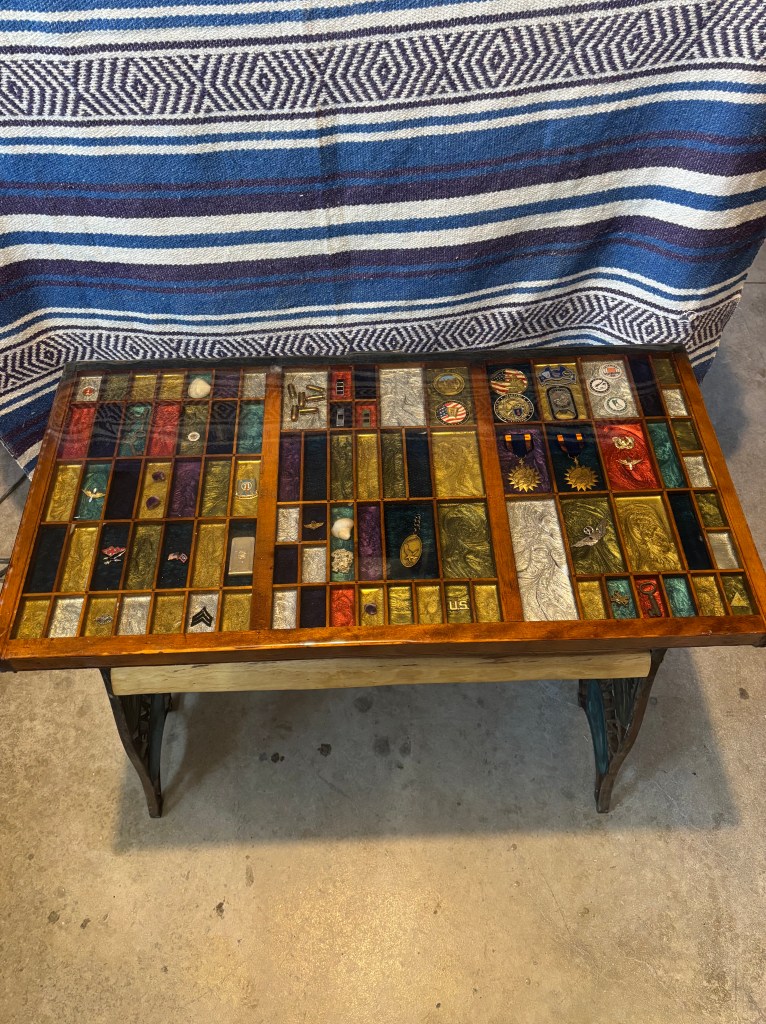
After retirement, I took up the hobby of making wood and epoxy tables, and other crafty creations. I’ve always enjoyed embedding military trinkets into my furniture pieces. I have several items that I will never sell, but will hopefully find a home with a family member who has interest in the history.
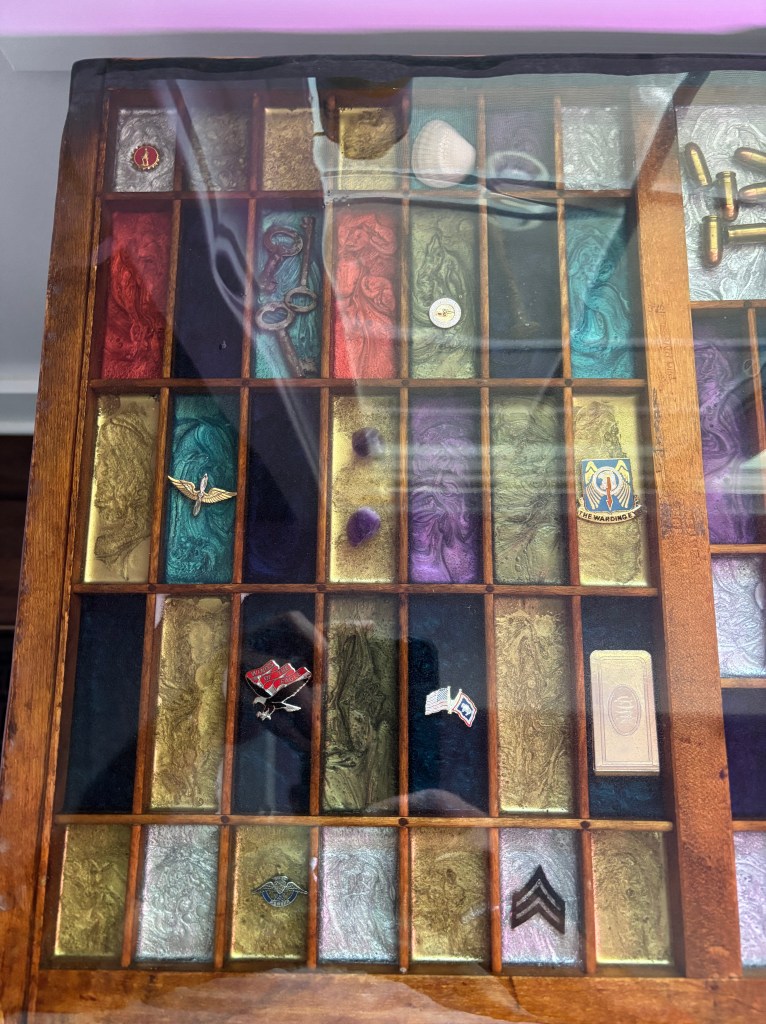
One such piece is a table built from a rescued printer’s drawer and an antique sewing machine base. I embedded items in the smaller compartments meant to organize printer’s letters and other supplies, with some family memorabilia and military history.
These can help to tell a portion of a story.
This table top will be broken down into three obvious sections; seven compartments across the top and five differing-sized boxes down the column. It will help identify the trinket I’m developing into what will hopefully become an interesting story. Not everything is going to be a blockbuster, for certain. The very first entrant helps demonstrate that for me.
It’s a lapel pin, just a soldier from old Ft. Riley, Kansas.
This takes up the spot because the move to Kansas from Germany was pretty monumental for our small, young family. At the time, I was a CW3 Instructor Pilot as our unit transformed from the 2-501st Aviation, 4th Brigade, 1st Armored Division, stationed at Fliegerhorst Army Airfield in Hanau, Germany. The year of the move was 2006. The President of the United States was George W. Bush. A transformative, strategic realignment of troops created a full swap of my unit into a 1st Infantry Division unit and moved it lock, stock, and barrel to Ft. Riley, Kansas.
I was able to get some timely and mostly secret information on the transition schedule, which allowed me to plan an effective move both for my professional career and for the best outcome for my then-wife and our six-year-old daughter, Mia, who was just finishing U.S. kindergarten on base in Germany through the Department of Defense Education System.
We were the second family to arrive at Ft. Riley. We grabbed an on-base apartment to call home until we could figure out a better long-term living situation if needed. The local area wasn’t ready for the announcement. They had lost the 1st Infantry Division years earlier, the economy had cratered and there were still open wounds, despite many promises that the storied division would return to the plains and heart of our amazing homeland.
We had lined up several homes to view, thanks to internet house shopping from Germany. One in particular had been listed at $88K when we first scheduled the appointment. But just a few weeks later, after the official announcement of the division’s return, that same house jumped to $250K.
We stayed on base.
The next year was brutal, difficult and high-paced. We had to build up a full air assault battalion out of what had previously been a VIP, General Support Aviation unit: 16 UH-60L Black Hawk helicopters, two flight companies.
An Assault unit is a different animal.
It has three flight companies, each with 10 helicopters. That’s a unit twice the size as before and now with a brand-new mission at an Infantry Division that included both mechanized and light infantry.
We were the ride to the battle.
I was personally happy to have a strong flight company; A Company, 2-501 Black Cats which now hung under 3-1 Aviation, but kept the Black Cats name. Our B Company remained the Black Knights. We had to scrap together a ragtag bunch of people and equipment to form our non-existent Charlie Company. I recognized right away that this would be pain for everyone if we didn’t get them stood up properly.
At the time, I was one of the only Instructor Pilots at Ft. Riley during the early days of the move. My services were highly valued and actively sought out. I also held designations as an Instrument Examiner and Standardization Instructor Pilot (SP). That gave me some bargaining power and a little juice with my new boss, LTC James B.. He was a SOAR (Special Operations Aviation Regiment ) aviator doing some time in the Big Army, grabbing a command. Huge potential it would go to combat. Then he’d return to SOAR command.
We got along. We were mission-focused. The customer was king, the Ground Force Commander and their troops are why we exist.
I made a risky move. I left my well-trained, well-formed, and disciplined Black Cats. Stepped aside. Made room for movement. One of my platoon IPs, Patch, got moved into the Company SP role as I made a lateral move to the most upset, poorly equipped, and set-up-to-fail group of disgruntled aviators I’ve had to witness.
I promised LTC Bradley I’d have them in fighting shape soon. I asked him to allow us to be called the Black Sheep. That group of 50 people making up 3-1 AVN Black Sheep were now considered “Plank Owners”.
The Shell
The next piece is a sea shell that was retrieved from the private beach front of Mark’s Vero Beach Florida compound. It makes an appearance in the beginning of a story as a glance into the future. We all knew Mark was going to be a wealthy man, there was never a doubt, not to me at least. Scooping up this shell outside of the home he moved to eight years after my retirement was foreshadowed while I was in Baghdad in 2003.
Our unit had made our way south out of Iraq, into the safe inferno that was the port of Kuwait. We readied our equipment to board cargo ships for their return to Germany. It was arduous, sun drenched, sweaty labor. During breaks for lunch, dinner, and after long hours; we watched CNN tell stories of the unit just replacing us encountering heavy resistance. They were being overwhelmed and the 1st Armored Division was turning around as reinforcement. I got the news I would lead our unit back into Baghdad the next day, the war wasn’t actually over, we were headed back for more and we had no idea how much we would swallow.
Within a few weeks I received a package of snail mail, the only kind invented at the time, a letter from Mark and some news clippings and real estate brochures about his amazing historic stately home in rural Vermont. He said hearing I got turned around for more war made him realize he shouldn’t hold back in life. That sea shell is proof positive that he made good on that advice.
Assorted Insignia
The rest of this pane includes three pieces of military trinketry that are worth hearing about. The first is the prop and wings. It is the symbol of Army Aviation and it is worn on the Class A uniform of officers. I was lucky to wear that insignia. As a Warrant Officer in my first half of my career we wore a different symbol, one we called the “Squashed Bug” or truly the Eagle Rising. It looks more like a bug smashed on a summer windshield than the majesty of a rising eagle, but I am a smart ass. The big army made the decision to drop the Warrant Officer history and embrace instead the branch one served as a Warrant Officer, in my case, Aviation, Duh.
The Warding Eye is the unit insignia of the unit I served in Germany, 2-501 AVN, the 4th Brigade. All the smart ass Warrant Officers such as myself called that the Warding Brown Eye. I think that should translate itself in all generations I would think. If not, try harder with the imagination.
The last is from my assigned unit in Ft. Campbell, KY the 101st Airborne Division, A co 9th Avn, the Black Widows. We were the Eagle Strike battalion as depicted by this insignia. It was the place in which Mia was born on the hospital of Ft. Campbell, Kentucky just two days after Christmas in 1999. The world was waiting for something crazy to happen in a few days as the calendar turned over to the year 2000. It was thought that computers were going to go berserk and everything would go haywire. It was called Y2K, it turned out to be nothing about nothing. Hilarious!
We run into a Wyoming and US combination flag lapel pin. I received this from a sitting US Senator outside of a Swedish Black Hawk Helicopter in Stockholm Sweden. I was stationed there to assist the Swedish Air Force to field and train their pilots and crew members on employing the newest version of the UH60 Black Hawk, the M model to an upcoming commitment in Afghanistan. They call the aircraft Helikopter 16. This new version was a flying computer and I was not a big fan. It had some very cool features and was amazing on some accounts, but the old dawg in me hated the fancy computer crap doing the flying. I liked the meat computers and eyeballs doing the driving. I didn’t trust the damn robots, still don’t.
That didn’t stop me from taking the job in Sweden and spending nearly three years doing some light coaching. I was doing a fun flight as the embassy was hosting a large contingent of US Senators around the capital. There happened to be a Wyoming dude there, my home state. No one is from Wyoming, so it was a cool thing. He gave me his email and that pen, said he would love to hear from me. Jerk was full of it and he never returned my emails.
Middle Panel
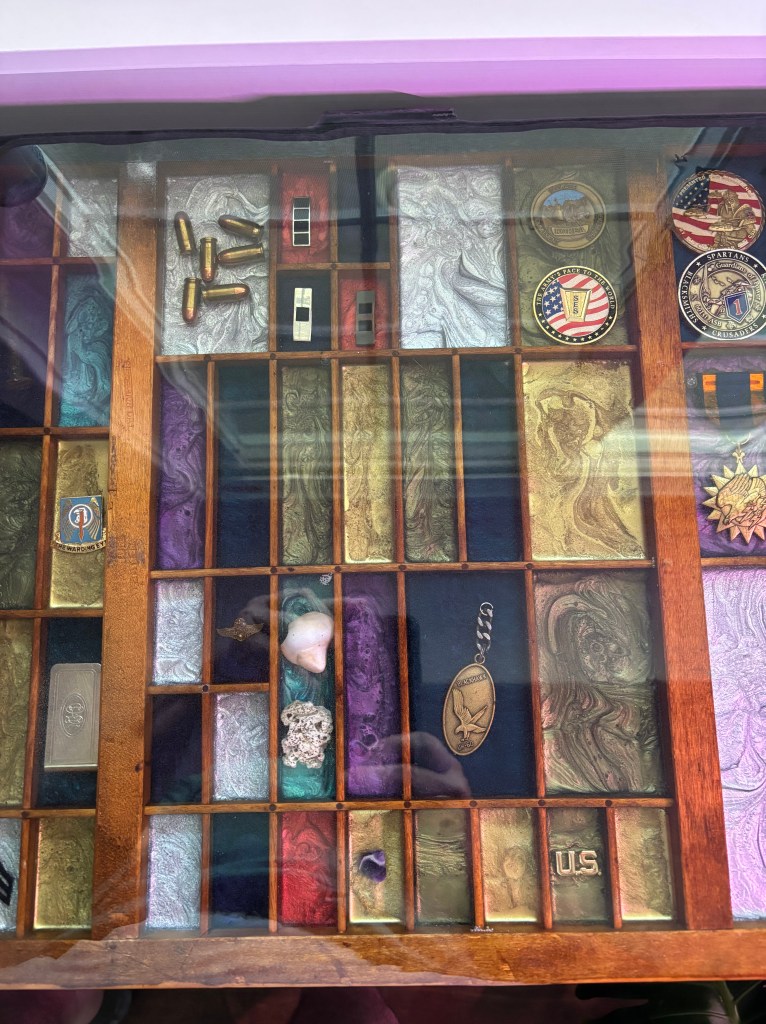
There is a handful of 9mm bullets, the kind I carried in my assigned M9 handgun. This pea shooter was my personal weapon assigned to me for combat. Obviously that wasn’t what I was bringing to the fight, but that is what they give the flight crews. There are many stories of heroism and gallantry as downed pilots emptied their pistol at an overwhelming enemy as they cowered near their wreckage with broken limbs, just waiting for the doom, hoping against hope that the death would be swift and not torture carried out for the video cameras and intent on terror. I always had a plan to survive, unless it was clear it was unrevivable. Then I would ensure there was one last bullet, one for me, one to ensure I wouldn’t star on the internet wearing an orange jump suit and having my head sawn off with a dull sword. Having those rounds forever under epoxy means that action will stay sealed away as well.
I have placed three rank insignia of the Warrant Officer. I was very proud to have been a Warrant Officer rather than the more heard of traditional 2nd Lieutenant through General. We are a more technical person. One that focuses more on being the pointy end of the spear, out front, planning the missions, maintaining the machinery of war, executing the war plan flawlessly, enduring whatever it takes to return with the intent of the commander completed and ready, willing and able to conduct further missions. I didn’t find a CW3 rank to place here and I highly regret that as it was my favorite and most demanding time in the army I faced. It was also the most rewarding even though it was the most costly.
The silver bar with one black square is the bottom of the barrel, the WO1, Warrant Officer 1. It is extremely difficult to earn that single dot, the competition to go to the Warrant Officer academy is fierce, few are chosen out of many that attempt. I got it the most rare of methods; from straight out of the civilian population, almost unheard of, but in aviation it is called; “High School to Flight School”, something they actually tried for several years and later abandoned. The name stuck though of those that applied and made it from the civilian world. The competition was so difficult that when I was selected only 4 out of 4000 were selected, I was number 2 in that batch, way weird to me. I was also a college graduate, so I changed the name to Bar Stool to Flight School, suited me better.
I did my time as a WO1 in Seoul South Korea. It was the worst thing the army could do to you back then, send you for a year to Korea without your family. I was a new Black Hawk pilot, new Warrant Officer, new husband, and off to the other side of the world I go. I learned to fly that aircraft as a soldier very well over there. I flew a large amount of the time, I was busy and learning my craft deeply. I became a pilot in command relatively fast and got the call sign; “Red Barron 33” I got to choose the number. I had a very tough personal situation as my wife decided the army life was not for her and she found a new daddy, literally. I was released from a shitty future. Promotion to CW2 is purely automatic after two years’ time in rank, unless one really screwed up. I took my second dot and a follow on assignment to the 101st Airborne Division, Ft. Campbell Kentucky.
I learned how to become a real pro army aviator, air assault daddy during my three years at Campbell. I was a Black Widow in 9-101 Avn. I was working my way up the chain of pilots, learning a whole new mission set in air assault. This is no joke and we are famous for getting our troops time on target. This means we get them there within 50 meters of the location and plus or minus 30 seconds of the time, the H-Hour. I eventually became a flight lead for the battalion, a big honor at the 101st. I was more excited about my nomination to go to Instructor Pilot school and on to Germany. Off to Rucker I went with a little one just under two years of age. Hanau Germany was to be home at the 1st Armored Division.
I was the newbie Instructor Pilot in the A 2/501 AVN Black Cats. I received a call sign of Black Cat 11 simply because I was the 1st Flight Platoon Instructor Pilot. I was working on my new skills with a pile of fresh flight school graduates. It was an extremely busy year in Germany as we went out to play war multiple times at what was known as the CMTC. It just meant a 30 day rotation in the box living in harsh German weather and navigating mud and low ceilings. Then the call to join forces mobilizing into Iraq was given to our small aviation unit to follow the 1st Armored Division to take command in Baghdad. In a flurry of activity to pack the unit for the unknown and for a timeframe that was just an educated guess, we departed in a short month. My departure was April Fool’s day 2003, Mia was 3 years old and thought I was off to fight the bad guys. I couldn’t communicate back home with them for over a month, then it was sporadic, snail mail letters was the way of the day, sometimes there was an internet connection to send and receive an email, but one had to wait in line for hours to get access and I had a ton of flying a work to do, so it was difficult at best.
This was a long miserable deployment in the heart of Baghdad at the airport. Our time was extended from 12 months to 15 months after our replacements, The First Cavalry Division, got their asses handed to them in the first few days of taking over the mission. Our entire Division turned around from Kuwait, loading cargo ships to return to Germany and our families. I had been selected for promotion to CW3 and held off on actually doing the promotion until I could get home and celebrate with my family, but the extra innings changed my mind and we had a quick ceremony to slide on my third dot.
I think it is important to begin my discussion about my three different deployments to Iraq, covering 42 months, with the events that occurred on September 11, 2001.
I was stationed with the 101st Airborne Division at Ft. Campbell, KY. I was in the final stages in preparation to move to Germany with a two month stop at Ft. Rucker, AL to participate in the UH60 Instructor Pilot Course. I had less than one week before I actually departed Ft. Campbell to begin my travels.
That day changed my life and the lives of most Americans dramatically. I am not sure if it can be well understood how this massive terrorist attack on our country felt, especially to those of us in the US military. Watching people dance in the streets of most Middle Eastern countries in celebration of the attack brought extreme dark thoughts to my mind as well as nervous feelings that come with the knowledge that I was going to more than likely go to war. Training for war is a much different feeling than knowing that all that training is going to be applied in a country far from home. I was stuck between incredible anger and fear about not only being in a war that I couldn’t really imagine as well as the knowledge that I would leave my beautiful family behind.
My wife and I were quickly approaching our third wedding anniversary and we were the proud young parents of a ball of happiness that would soon turn two years old. At the time, I couldn’t imagine how terrible it would feel to be separated from them while I was off fighting a war. I knew that I had to harness all of those feelings and apply them to my efforts and skill that I would need to survive whatever my future held so that I could be back in the safe embrace of my very being, my family.
As the months progressed, it became apparent that not only would the US look for the perpetrators of this ghastly attack in the mountains of Afghanistan, but our President intended to ensure that this type of attack would not occur again. We would also take matters into our own hands and put an end to any other nation that harbored or sponsored terrorism toward our country and it’s civilians. We would put a target squarely on Saddam Hussein and his army in Iraq. It was well understood that Iraq had weapons of mass destruction in their possession and they had a plan to use them against our nation. George Bush and the entire Congress of the United States agreed that we needed to go into Iraq and take that capability away from them. Many nations agreed with the US position and joined an international coalition to assist the US efforts.
My family and I arrived in Germany at the end of 2001. I began the rigorous task of learning my new craft as an instructor pilot. I was in high demand as the unit that I joined was a very inexperienced group of aviators fresh out of flight school. The more experienced instructor pilots were on their way out and off to other assignments. I spent countless hours in flight as well as on the ground training a group of 50 aviators equipped with eight Black Hawk helicopters on the craft of war fighting. The challenge was obviously that I knew nothing of actual fighting in a war outside of all the years I spent pretending to fight wars. After 12 months, our number was called to join the new war effort in Iraq. We watched from television as the US Army rushed into Iraq and quickly took down the Iraqi Army and marched straight into Baghdad to capture the capital.
My unit got the call while we were away at a training facility in southern Germany conducting aerial gunnery training. We would have less than a month to complete our training, pack all our gear that we would need, prepare our soldiers with all the necessary official paperwork, and say good bye to our families. That month was filled with extremely long days and tough subjects to work out, such as writing our last wills and testaments.
We didn’t really know what to expect, we knew we were set to go into the Capital and live and operate out of the Saddam Hussein International Airport. We packed everything that we owned as a unit thinking that we would be living out of tents in the dessert and conducting flights all around the dangerous city of Baghdad. We packed this short time with the work of loading all of our vehicles and containers onto trains in preparation for delivery into Kuwait. We finalized our efforts by flying all of our aircraft to the port city of Antwerp, Belgium for shipment into Kuwait.
My imagination was running wild without having any tangible picture in my head or understanding of what we were going to do. We all knew why we were headed to Baghdad, to avenge the terrorists that attacked our own soil. All of my colleagues were filled with American Patriotism and ready and willing to do anything that was ordered of us to protect our nation from ever having this happen again. The media was a frenzy, I wished to never hear the term Weapons of Mass Destruction again. WMD could come in any flavor, chemical or biological, and worst of all Nuclear. We knew that Saddam had the willingness to use horrible chemical agents against human beings, he had already killed tens of thousands of his own countrymen in the north of Iraq with mustard gas and blister agent. He had refused the international agency of Nuclear inspectors to take a look to prove his guilt or innocence, it could only be thought he was hiding nuclear weapons.
Finally the day arrived. I departed my apartment at 0300 without even waking my family for one more teary goodbye, I couldn’t bear to have another emotional event. I began the longest and most painful journey of my life. Each of us were deathly quiet and all alone with our thoughts and anxieties. In the Army we quickly get used to what we term as “hurry up and wait”. The journey to Kuwait took an excruciating 36 hours to complete. One of the first things we witnessed was on a TV during one of our long waits, President George Bush was on an aircraft carrier with a huge sign in the back ground that stated; “Mission Complete”. Many of my colleagues appeared upset and voiced that we “missed the war”. This was an obvious embarrassment and complete miscalculation.
Once we arrived we got extremely busy. We had to receive all of that equipment from the ports of Kuwait City and then begin initial training. I was so busy that I had not had the chance to worry anymore about what was going to happen. I needed to get all of our pilots trained in the tough art of landing a helicopter into the sands of the dessert. After nearly a month of rigorous preparation, we launched for our first time north of the Berm that separates Kuwait and Iraq. It was like flying across the moonscape with no signs of any living creature but plenty of evidence of our visit a decade previous. Hundreds of destroyed machines of war lined the only highway between the two countries.
As we flew north, it was like traveling in a time machine. I saw small villages with buildings made from nothing but dried mud. Small children out in the middle of the dessert tending a small flock of sheep with hours of walking time in every direction before encountering any civilization. The more north we went the more things began to develop. It went from looking like the time of the dinosaurs to the stone age, then to the bronze age and eventually into a massive city that was part modern and opulent mixed with horrible poverty. It was a pure case of some have everything and most had nothing. Baghdad contained dozens of ornate palaces and government buildings surrounded by enormous, lavish homes, but the neighbors were massed inside of structures that could barely be called homes. Car traffic in the city was crammed with no order that I could discover. The pollution and smell of the air could cause your stomach to empty it’s contents.
We landed at the newly named Baghdad International Airport to witness total destruction of the runways. The US Air Force had ensured that zero Iraqi aircraft could take to the skies by bombing all intersections of the airport to prevent airplanes from moving around. They preserved the majority of the runway and airport complex for our eventual occupation. Reconstruction would be needed but it would be minimal. At first the runways were only capable for helicopters. This was the case for all airfields in the country.
My unit was supposed to live in one of two enormous hangars that normally were used to store and maintain giant Boeing 747s from the suddenly out of business Iraqi Airlines. The hangar was incredibly large and at the beginning approximately 2-3000 people started to live there. We found a horrible mess and terrible conditions to live and work from, but we began the arduous task of cleaning and clearing thousands of pounds of junk from the airline industry. Army ingenuity took full blossom as we captured airline seats and sections of airplanes to create our own make shift housing. The temperatures were sweltering, the mosquitos thick and hungry for our blood. Many nights it was impossible to sleep as the sweat made pools on our cots and the incredible clatter of machinery and aircraft noise mixed with the smells of diesel exhaust continued around the clock.
Our Army had moved so fast that it out ran our supply and logistics chain. We found ourselves without water or portable toilets for weeks. The conditions were horrendous, yet we still needed to conduct flight operations. The inside of a Black Hawk reached well over 50 degrees celsius. The added weight of our flight gear and body armor drained our flight crews on our long dangerous flight missions.
The first two months were filled with us flying around our infantry counterparts to see their territory from the skies to better understand the conditions they faced. We also moved troops around to and from small camps to enormous bases. We had the mission of flying our Generals around to meet with other commanders. This meant I was able to go into and witness some amazing sights. Many of our bases were placed inside of captured palaces and government buildings. I walked into an enormous palace that was half complete destruction and half sculptured marble and golden ornate decoration.
Our flight technique was to fly incredibly low through the city. We used the buildings the same way we would use hills, canyons and valleys. The idea was to only present ourselves as a target to a small portion of possible enemy for a very short time. We flew very low and very fast. This added even more danger to an already tough situation. We had many obstacles that were very hard to see due to the fact that everything was covered in a thick layer of dust. This caused all the towers and power lines to appear the same color as the back ground. Still we knew it was safer to put ourselves near the obstacles because we were more afraid of the surface to air missiles that were everywhere. The evidence was in the 16 Black Hawks that were shot out of the sky by various models of shoulder fired missiles. It is with a heavy heart mixed with horrible guilt that I feel so thankful that none were from my unit.
When we flew at night we gained more altitude because we simply couldn’t see the obstacles anymore and we hoped that the enemy couldn’t see us either. Night flights confirmed how dangerous the enemy activity really was. We could see the tracers from bullets being shot into the sky in every direction, this we couldn’t see during the day time. The bullets never really got close and we always said they were firing because of us and not at us. They couldn’t see us so they fired at our noise. That was good news for us because the sound carried strangely around the city and we could simply avoid where they were shooting. The power in Baghdad was nonexistent when we arrived. Night time was totally dark over the city. As time continued, the US restored much of their power facilities that were our strategic targets at the beginning of the war. Eventually large sections of Baghdad were well lit at night, but they had rolling black outs. It was eerie to witness an entire section of the city lose lights and another section light up simultaneously.
Flying in the daytime allowed us to feel like we were actually doing something very good for the country. Saddam Hussein had ensured that he kept his citizens unaware of the rest of the world. It was forbidden to have television, there was nothing but one Iraqi channel to see. Once Saddam was gone from power, free market enterprise began. It was very visible to see that satellite TV was first on the list of priority. At first the tops of the apartment buildings had small radio type antennae. Suddenly satellite antennae began to sprout up on a few buildings. Within weeks there was not a rooftop that didn’t have multiple satellite antennae all over the city. People that used to sell hardware, clothing, or produce turned to selling satellite TV systems. Doctors and lawyers soon started selling satellites as well. In fact, all trades began to suddenly offer their assistance to the US to fix poor wiring and electrical work, too bad they were not trained on this work. It felt like the citizens of Iraq were extremely happy with their new found freedoms upon the departure of Saddam Hussein.
As for weapons of mass destruction: it became obvious to me that it would be impossible to discover where it was hidden. This country is one giant open area in which to hide these WMD. We found thousands of military bases, most of them in horrible shape and not from recent bombings, maybe from our previous visit in the 90s. Hundreds of bunkers designed to store ammunition were littered all around the country. It would take hundreds of thousands of men and years of searching to cover it all. I called in the location of so many that I dare not try to estimate. I called in the position of the same 20 plus tanks every day for more than 8 months with never seeing anyone come and get rid of them. It seemed that the Iraqi Army just jumped out of them and left them exactly in the same spot, it turns out this is exactly what happened and it happened all over the country. Now I know that the Iraqi military had no plan on maintaining their equipment, mainly if and when it broke down, they abandoned it in that place, or maybe stole parts to fix another vehicle. The evidence of their waste was apparent all over the country with the bones of war machines rotting in the tough conditions.
Each of these military facilities obviously still had lots of ammunition available. The Iraqi Army had disbanded but that didn’t stop attacks from occurring against US military bases. In fact, we endured multiple attacks each and every day at Baghdad Airport. It was exhausting to be afraid all the time. Rocket and mortar attacks were so common that they eventually became “normal”. Most of my buddies and I adopted the concept that if I was meant to die today, then today was my day. We quit running for shelter every time rockets and mortars began landing. I know I always feared that I would be okay if I stood still, but maybe if I was running toward a shelter, the bombs would land on me as I moved. So we all stood our ground and wondered if today was the day. It sure doesn’t seem that this mentality is one from a sane person, but sanity has a shifting definition in a combat zone apparently.
With all of this happening, my family never left my thoughts. They were always in the back of my mind while I was out flying or waiting for the General to finish his meeting at an exposed base in the middle of the city. While they were on my mind, there was very little contact back home. I wasn’t able to call home for over three months just for a moment to tell them I was fine and not to worry about me. We did communicate through letters, but it was very hard to decide what to write. I for sure never let them know about the dangers I was facing each day. Eventually a small internet cafe was formed and we could wait in line for an hour to spend fifteen minutes at a computer equipped with email capabilities, this wasn’t easy to do with constant flights or planning for upcoming flights. Unfortunately, others did not show the same discretion with communication to home. If someone told their wife about a recent attack that the rockets got too close for comfort, it only took minutes to spread like wild fire to the network of wives back home. I gave the advice to my wife not to listen to anyone. If I wasn’t the one to give the news, consider the news to be exaggerated and over embellished.
Our work load stayed at a steady pace and we grew accustomed to that pace with days blending into each other. We found a way to make things acceptable even though it was disgusting. Our baselines had all shifted. We laughed together, we fought like cats and dogs with each other, we bonded like a dysfunctional family. We all found small groups to hang around with, going to dinner if I wasn’t scheduled to fly was something to look forward to with my buddies. We talked of the things we missed and what we were going to do when we got back home. We all discussed plans to get out of the Army, we had all had it with this war. Eventually, we closed in on the year mark, news that we were going to get a replacement was given, we were going home.
The new unit showed up, we had a big plan to show them the ropes, discuss how we were flying, showing them places we didn’t fly near. The new guys had an opinion that we were doing things wrong, they would change things once we were gone. They thought we were exaggerating the things we saw and the amount of enemy we encountered. I know I didn’t care, I showed them everything, gave them all of the truth and how we handled things, cautioned them about everything, worried that they would not listen, but again, a part of me didn’t care. We had done a lot and now it was our time to go home.
We excitedly made our exit to the south and crossed the border again into Kuwait. On our departure, I made the mistake of telling Baghdad tower that we would not return. We flew near aerobatics in celebration as we crossed into Kuwait. Iraq was behind us, we were done with this war. Then the work began to pack it all back up. First we had to completely wash and clean all the Iraq away from our equipment, vehicles, and aircraft. It was an extremely time consuming and difficult operation in the extreme heat. This task, though very difficult, was done with pure joy as it meant that we were headed home and out of harms way.
I put together a list of family and friends and sent an email letting them know that I was out of Iraq and only days from departing for Germany. During breaks for meals, we all watched intently as the war really began turning from the normal days we had witnessed to a very dangerous and explosive situation. Reports of three helicopters shot down in one day came over the news and we were sad to see that it was from the unit that we just trained to take our place. In fact, one was shot down at a location that I purposely demonstrated to avoid at all costs. The rumors and speculation began to run rampant that we would not go home but turn around and go back north to assist. Surely this couldn’t and wouldn’t happen, we were days from going home. In fact, the majority of our unit had already departed and arrived in Germany to a big joyous reunion with family.
We gathered to conduct a brief for the last flight of moving our aircraft to the port for shipment. Our commander did not look as happy as he had earlier in the day. He gathered us with a somber look as he told us the news that our plans had changed. We needed to get back to Baghdad as soon as possible. In fact, I was placed on the schedule to lead all eight aircraft back north where we would receive further orders. This news hit us in the stomachs like a ton of bricks. I had never experienced such a feeling, this was much worse than when we found out we were going to Iraq. We now knew exactly what we were facing. The orders told us that we would be extended another six months. The air was out of our spirits, six months is a long time especially when the war was turning so bad. I wish that I could say it took guts to climb back into that aircraft and fly back to Baghdad.
The next day, I was given a mission to fly to the worst parts of the new flare up in violence. I was to fly to the four hottest sections of the country to include Fallujah. Just before climbing in the aircraft, my buddy and I stopped to look at each other and commit that we would be safe and cover each other. We looked in the direction of our departure to see an Apache attack helicopter hovering over one of the most dangerous highways around, we were talking about how those new guys didn’t listen. Suddenly we witnessed a cork screw smoke trail come from the ground at lightning speed and hit the aircraft dead center. The Apache immediately turned into a huge fire ball and fell to the ground with pieces flying in all directions. The only thing worse than seeing that happen was knowing that we needed to take off in a few minutes in that same direction. That flight day lasted nearly twelve hours. Nothing in particular happened to report but we were so scared and I have never flown so intense and aggressive before or after that day.
Again, we got used to the new level of terror and fell into a scheduled day. The attacks against us on the ground had doubled in frequency, it felt safer to fly than be on the ground at the base. At least in flight I could do something to control my destiny instead of wondering if today was the day. I couldn’t bear the thought of being killed while I ate dinner or while I slept. At least let me go fighting was all that I could think. Not a healthy way to think.
It wasn’t lost on us that there had been zero Weapons of Mass Destruction found in Iraq. The news was full of speculation on why we really went into Iraq. It was said it was because of the oil, because of unfinished business between Saddam Hussein and the Bush family, but it didn’t matter to me or my service members that went. We went there because we felt like we were defending our country against an awful terrorist attack and we were preventing it from ever happening again. We went there because we were ordered there, we are soldiers and we do what we are told. We kept fighting as hard as we could because of each other and our families and friends. We were determined to take all of our buddies back home with us. We might think of politics and might even have an opinion about the war or what brought us to war, maybe even on how to end the war. But we keep that to our own thoughts and concentrate on staying alive and assisting our brothers on the ground to complete their mission and to stay alive. We think like a team, even if we have never met each other. We felt the loss of every soldier and did everything we could to prevent more. Mostly, we can only do all of this by keeping our small unit together and safe.
After three months had gone by, we were told that we were departing again. I am sure no one believed this to be true. No one sent home emails of joy or news that we were headed home. The day I was set to leave I was still skeptical. I went to my aircraft and along the way our Brigade commander stood in front of our progress. He wanted to shake each of our hands and tell us that we had all done a great job. We still didn’t believe that we were going home yet, that feeling was something I never wanted to feel again. Upon departure of Baghdad International Airport, not one person announced that we were headed to Kuwait, not a sole uttered that we would not be coming back. There was no celebration as we crossed into Kuwait, we were all still waiting for the hammer to fall. We went through the washing of our trucks and aircraft again, still miserable, yet there wasn’t any joy this time. Still waiting for the hammer to fall. I waited close to a week sitting in Kuwait waiting to hear the news that we had been fooled again, but this time it never came. It wasn’t until we actually lifted off of the runway in Kuwait City that I really felt like we were going home this time. The other soldiers on the plane must have felt the same way because a huge roar of whistles and applause erupted without coordination.
Once home and reunited with my family, I really felt like I was a lucky man, I felt like I had gone to war, did dangerous and exciting things with skill and passion and that is what made me survive. My hard work ethic and long hours along with pushing my colleagues had paid off. My daily motivation to make good use of my time away from my family had paid off. I would never have to set foot on the ground again in that horrible country.
Months after getting home and getting back to a normal schedule, it was announced that the President decided to shift the US forces around the globe. My unit in Germany was one that was picked to shuffle back to the United States. My unit was destined to move to Ft. Riley, Kansas. The middle of no where, not a place that I wanted to go. It also meant that we would not be capable of being sent to the war again until we closed up business in Germany, moved it all to Kansas, and began retraining the whole unit again. This time we were taken apart at the seams. We would only be a shell of our former unit. We would be joined by a mish mash of other units and form the new Army Aviation way of organizing, the Combat Aviation Brigade. We were told and fully believed that we wouldn’t be fit to fight for at least two more years upon reaching Ft. Riley. That would be nearly three years by the time we were war eligible again, surely the war in Iraq would be over by then.
Challenge Coins
We next see a couple of challenge coins displayed. Neither are extremely rare or special, those I placed in a bar top already. A challenge coin is an interesting trinket that comes with tradition. A commander or someone in a leadership role in a unit will have a challenge coin that represents the unit. They give these to soldiers that have done above and beyond the call of their job, they went the extra mile. It is a cheap and effective way to encourage others and create a cool community. I got lucky in my first unit in Korea as we flew many high profile VIPs that had challenge coins. I was given many that first year. One is here in this panel and represents the Chaplains of Korea. When a challenge coin is given it is handed in a handshake. Now that this coin is in possession it can be used in a game. In the day, many used to go to the Officer’s Club. If someone presented a challenge coin, it must be matched or that challenged person owes a drink. If the coin is met then the challenger must buy the drinks.
One of my favorite trinkets in this table is the Sikorsky UH60 key chain. This bronze chain is only given out to graduates of the UH60 Black Hawk Aircraft Qualification Course. We all used to wear them hanging out of the left breast pocket of our one piece flight suits. It was the coolest thing, and completely unauthorized. Eventually the army got rid of our cool flight suits so we would look more like infantry soldiers, then the key chains were no longer displayed, a loss of a great tradition. I received that key chain in August of 1996 and it went with me all over the world. I flew with that thing in Alabama, Florida, South Korea, Tennessee, Kentucky, hell, the majority of the United States, Germany, Austria, Switzerland, France, Belgium, Kuwait, Iraq, Sweden, Norway, Denmark.
My very favorite trinket belonged to my father, Larry E. Hastings. This is an Aircraft Owner’s and Pilot’s Association set of wings. AOPA is a huge organization that almost every single civilian pilot belongs as a member. They lobby congress and supposedly keep general civilian aviation capable of continuing. A close looks reveals it was a 20 year anniversary pin. Larry was an aviation legend and pioneer, especially for the sparsely populated state of Wyoming. In the next panel over I have embedded his other FAA honor which was to become a Diamond Level Master Aviator, a high honor.
The Third Panel
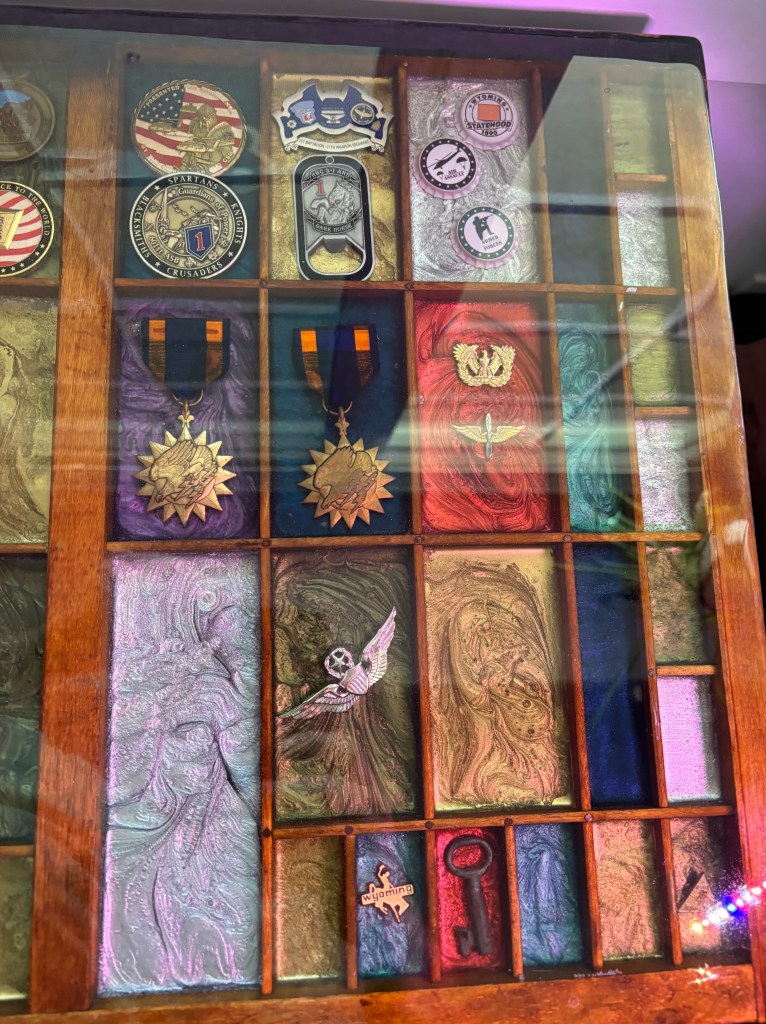
This final panel of the table holds several types of challenge coins from my time in the suit. It also holds two of my seven air medals. I am not completely certain what these two are for but I can pull two good examples of what it takes to receive one of these trinkets. First, you have to be in combat. Next, the aviator must have demonstrated meritorious achievement or heroism in aerial flight. My record shows that I have six Air Medals and one Air Medal with a Valor device.
The Air Medal
With Valor
Chief Warrant Officer Three Matthew D. Hastings
Charlie Company, 3rd Battalion, 1st Aviation Regiment
For Exceptionally valorous achievement while participating in aerial flight during Operation Iraqi Freedom. While under fire, Chief Warrant Officer Three Hastings provided effective cover fire for troops exiting another aircraft. Chief Warrant Officer Three sighted armed enemy moving towards the aircraft on ground and with complete disregard for his personal safety, he set up a door gunner engagement. Chief Warrant Officer Three Hastings sustained a shrapnel wound to his leg from the debris of the shattered round, fuselage, and seat. Chief Warrant Officer Three’s Valorous actions are in keeping with the finest traditions of military service and his performance in combat reflects great credit upon him, the 1st Combat Aviation Brigade, Multi National Division-North, and the United States Army.
November 16, 2008. Signed by MG Mark Hertling
 Crafted by Valor
Leave a comment